
Enhancing Pharmacy Students’ L2 English Proficiency: Vocabulary Knowledge and Collaborative Learning in Reading

Enhancing Pharmacy Students’ L2 English Proficiency

Vocabulary Knowledge and Collaborative Learning in Reading

  • Haruko Shimazaki/2026.2
  • JPY 6,000/A5 size, softcover, 180 pages
  • bookdesign: Toshinobu Nagata

This study bridges its inspiration and purposes by demonstrating the transformative potential of reading as both a skill and a gateway to professional growth. By addressing the unique challenges faced by pharmacy students, it provides a framework for enhancing EMP proficiency and preparing future pharmacists to meet the demands of an increasingly interconnected world. (from Chapter 7: Conclusion)
This study addresses these challenges through the following objectives.
– Enhance Reading Proficiency
– Support Vocabulary Development
– Evaluate Collaborative Reading (CR)
– Advance Evidence-Based Teaching Practices
– Contribute to Global Pharmacy Education (from Chapter 1: Introduction)
(ISBN 9784868161301)

Table of contents

Acknowledgements

Chapter 1 Introduction
1.1 Motives for This Study
1.2 Purposes of the Study
1.3 Organization of the Study
1.4 Three Domains of Subject Development Study and Their Connection to This Study
1.5 Ethical Considerations

Chapter 2 Theoretical Background
2.1 Research Context in Pharmacy Education
2.2 Literature Review
2.3 Summary of Chapter 2

Chapter 3 Study 1: Investigation of Japanese Pharmacy Students’ English Vocabulary Knowledge
3.1 Research Questions
3.2 Methodology
3.3 Results and Discussion
3.4 Conclusion of Study 1

Chapter 4 Study 2: An Analysis of Japanese Pharmacy Students’ Knowledge of EMP Vocabulary: Its Breadth, Characteristics, and Difficulty Order
4.1 Research Questions
4.2 Methodology
4.3 Results and Discussion
4.4 Conclusion of Study 2

Chapter 5 Study 3: Verification of the Effectiveness of Collaborative L2 Reading Comprehension Among Japanese Pharmacy Students
5.1 Research Questions
5.2 Methodology
5.3 Results and Discussion
5.4 Conclusion of Study 3

Chapter 6 Study 4: Japanese Pharmacy Students’ Perceptions of CR
6.1 Research Questions
6.2 Methodology
6.3 Results and Discussion
6.4 Conclusion of Study 4

Chapter 7 Conclusion
7.1 Pedagogical Implications
7.2 Practical Applications of Pedagogical Implications
7.3 Limitations and Suggestions for Future Research
7.4 Overall Conclusion

References
Appendices

Author

HARUKO SHIMAZAKI
Haruko Shimazaki is an Associate Professor at the Center for Language Education, Tsuru University, Japan. She holds an MEd from the University of Bristol, an MA in TESOL from the University of Chichester, and a PhD in Education from Shizuoka University. Her research is grounded in second language acquisition and English language education, with particular focus on vocabulary development, collaborative learning, and reading pedagogy in higher education and English for Medical Purposes (EMP) contexts. She has published peer-reviewed studies on pharmacy students’ EMP vocabulary knowledge, collaborative reading, and research-informed instructional design, including articles in the Journal of Medical English Education and the Modern Journal of Studies in English Language Teaching and Literature. She is a member of major professional associations in Japan and internationally, including JACET, JALT, JASMEE, and ThaiTESOL, and has served as a reviewer for an international ELT journal. Her professional qualifications include Cambridge CELTA and Cambridge DELTA (Module 2).
Order this book

Amazon

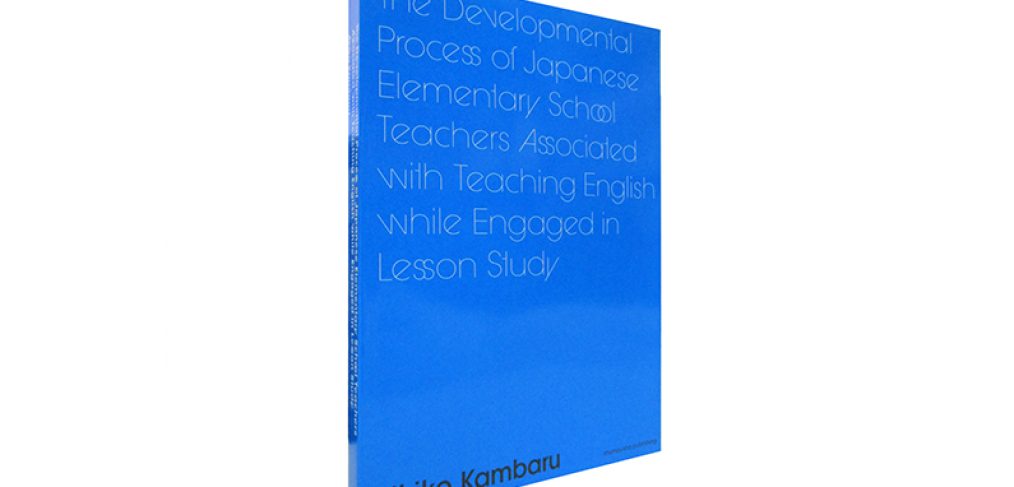
The Developmental Process of Japanese Elementary School Teachers Associated with Teaching English while Engaged in Lesson Study

The Developmental Process of Japanese Elementary School Teachers Associated with Teaching English while Engaged in Lesson Study

  • Akiko KAMBARU / 2019.2
  • JPY 5,900 / A4 size, softcover, 210 pages
  • bookdesign: Toshinobu NAGATA

This book analyzes the current situation of English language education in elementary school about in-service and pre-service teachers using the method of lesson study and qualitative approach. This presents new teaching methods and attitudes for implementation of English education based on each pedagogical and English experience.
(ISBN 9784861106347)

Table of contents 

Chapter 1 Introduction
1.1 Motivation of this study
1.2 Purpose of this study
1.3 Outline of this study
1.4 Summary of chapter
Chapter 2 Literature review
2.1 Research on teaching English in elementary schools
2.2 Research on teachers’ thinking in professional development
2.3 Research on lesson study
2.4 Methodological perspectives and paradigms
2.5 Summary of chapter
Chapter 3 Methodology
3.1 Modified grounded theory approach (M-GTA)
3.2 Analysis procedure of M-GTA
3.3 Validity and reliability
3.4 Summary of chapter
Chapter 4 Study on pre-service teachers
4.1 About the school
4.2 Participants
4.3 The teaching practicum schedule
4.4 Data collection and analysis
4.5 Results and discussion
4.6 Summary of chapter
Chapter 5 Preliminary study on in-service teachers
5.1 About the school
5.2 Procedures of the school-based lesson study
5.3 Research lesson and post-lesson discussion
5.4 Findings
5.5 Summary of chapter
Chapter 6 Study on in-service teachers
6.1 About the school
6.2 Participants
6.3 Procedures of the school-based lesson study
6.4 In-service teachers’ views on teaching English
6.5 Descriptions of lesson study cycles in this school
6.6 The developmental process of in-service teachers
6.7 Summary of chapter
Chapter 7 Discussion
7.1 Developmental process of pre-service teachers (research question 1)
7.2 In-service teachers’ views on teaching English (research question 2)
7.3 Developmental process of in-service teachers (research question 3)
7.4 In-service teachers compared with pre-service teachers
7.5 Additional findings from this study
7.6 Summary of chapter
Chapter 8 Conclusion
8.1 Summary of the study
8.2 Theoretical implications
8.3 Pedagogical implications
8.4 Contributions of the study
8.5 Limitations of the study and directions for future study
8.6 Concluding statement

References
Appendices
Index

Author

Akiko KAMBARU
Ph.D., is an Associate Professor of Teacher Education at Tsuru University in Japan. She has 23 years of teaching experience at elementary schools in Japan and the United States, and has been an instructor for teachers. Her major is teaching English to Japanese children. Some of her achievements are below:
Kambaru, A. (2017). Elementary school teachers’ developmental process associated with teaching English in school-based lesson study. JASTEC Journal, 37, 103-118.
Kambaru, A. (2017). Jugyokatei to gakushushidoan no tsukurikata [Lesson procedure and how to make lesson plans]. In T. Higuchi, T. Kagata, E. Izumi, and T. Kinugasa (Eds.), Shinpen shogakko eigokyoikuho nyumon [A primer of Elementary school English education, new edition] (pp. 178-184). Tokyo: Kenkyusha.
Kambaru, A. (2007). Gakkoseikatsu no arayurubamende eigo wo tsukau kankyo wo tsukuru shogakkogakkyutannin no kokoromi [A challenge of an elementary school teacher to make an English environment in school]. Dai 56 kai Yomiuri kyoikusho saiyushushojyushosha rombunshu [56th Collection of papers of the highest award winner of Yomiuri education prize], 103-114.

Order this book